VHF 2 meter FM Repeater
This is the primary repeater used by the club and Ames/Story County area.
The VHF repeater operates on 147.240 MHz with a positive (+) 0.600 MHz offset. A PL tone of 114.8 Hz is required and transmitted by the repeater. Any licensed amateur radio operator is welcome to use the repeater.
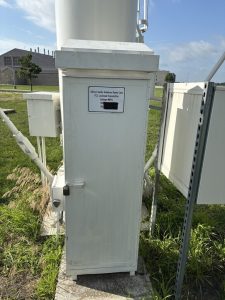
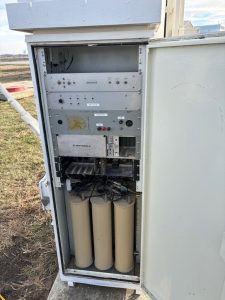
UHF 70 cm FM Repeater
The UHF repeater operates on 443.250 MHz with a positive (+) 5.000 MHz offset. A pl tone of 114.8 Hz is required and transmitted by the repeater. Any licensed amateur radio operator is welcome to use the repeater.
History
History of the Ames Repeater Association
As recalled by John Maurer WØDP (ex-NAØS, ex-WAØYGJ)
The Ames Repeater Association was founded in the mid-1970’s by a group of local hams interested in putting a 2 meter FM repeater on the air in Ames, Iowa. The Ames Repeater Association was created to formalize the organization.
The first repeater consisted of a General Electric TPL (Transistorized Progress Line) receiver, one of the poorest receivers ever designed. It was paired with a VHF Engineering Inc TX144 transmitter that put out about 2 watts. Steve Hand WAØTVK spent quite of bit of time cleaning up the spectral output of the TX144 exciter in the EE lab, eventually making it clean and reliable. A CW-ID’er designed around a SN74154 and a diode matrix (the old K2OAW ID’er) and a couple of NE555 timers was used for control. The controller was built by John Maurer, WAØYGJ (now WØDP).
The first repeater was on 146.76, or 16/76 as it was known at the time. The Cedar Rapids repeater was also on 16/76 but it rarely caused interference with the Ames repeater.
During the school year, the repeater was operated from Steve’s dorm room on the 9th floor of one of the Tower dorms, with the antenna taped to the window.
The repeater was all solid state and completely silent – which was unusual at the time. Most repeaters had one or more relays that operated each time the repeater keyed up.
Then came a Motorola Motrac Sensitron-A receiver which made the repeater hear weaker signals much better. The squelch circuit was eventually replaced with a Micor squelch, which minimized the squelch burst heard at the end of each transmission. In its time, the Sensitron-A receiver was the best there was. Excellent selectivity and great audio quality. This receiver served well for many years. The receiver was quite sensitive, like 0.25 uV for 20dBQ without a preamp. It was paired with a 45 watt Mocom 70 exciter and power amplifier. Eventually a new set of WACOM cavities, model WP-641, an excellent set of band-pass band-reject duplexer was purchased. Unfortunately, we didn’t have the foresight to keep the cavities when we sold the .76 repeater. The duplexer went with the repeater.
That repeater was the first one located at the NADL (now NADC). The antenna at the time was mounted on brackets on the side of first building south of the main building. The antenna was probably 35 or 40 feet in the air, but since the site is fairly high, the coverage was decent.
The current repeater is built around Motorola Mitrek RF gear. We split apart the Mitrek RF board, and built up the receiver and transmitter in separate shielded enclosures. The Mitrek receiver squelch is unusable in repeater applications (actually any carrier squelch applications), so I built up a Motorola Micor squelch circuit to replace the Mitrek squelch.
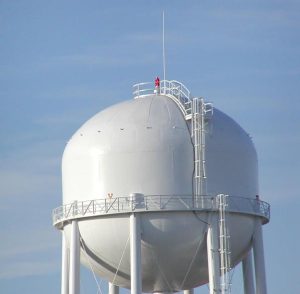
About 1980, I built a repeater controller around a Zilog Z-80A microprocessor and wrote a real-time task manager in assembly code. It was developed and used on the NAØS repeater on 147.24 mHz and 443.25 mHz, then later used when we eliminated the 146.76 mHz repeater and moved the 147.24 mHz repeater to the NADC (then NADL) water tower in 1988.
As of this writing (2008), that same controller is still running the WØYL repeater.
In 1982, the founders of the ARA dissolved the organization and donated the repeater, the Repeater Fund and other club assets to the Story County Amateur Radio Club (SCARC). By then, we were all members of both organizations anyway and could see no point in maintaining the Ames Repeater Association as a separate organization.
The repeater is funded by user donations. Donations can be made directly to the Story County Amateur Radio Club. Please make a notation that the monies are for the repeater fund, and they will be tracked separately by our club treasurer.
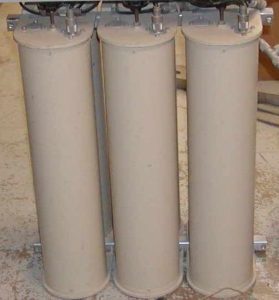
Our Repeater Duplexer As recalled by Gerald Johnson KØCQ (January 2005)
I built the duplexer from cavities I bought at a Cedar Rapids Hamfest long ago. I recall it was one at the 5 Seasons convention center but maybe Hawkeye Downs. Anyway, it came as a collection of 7 DB Products cavities, no cables. The seller said, “insult me with an offer” so I offered $25 a cavity (actually $150 for the collection) and he took it nearly instantly. When I got the cavities home, I found that three of them had been apart and the center conductor had sleeves of cruddy (mixture of green corrosion and paint) 1-1/2 inch copper pipe supported on long self tapping screws. I think they hoped to get the cavities down to 145 MHz. I cleaned them up and made up connecting cables of RG-223 and they give enough isolation for a 25 watt repeater and have proven to have good stability. In tuning them I did discover the importance of well shielded cables for generator and receiver and the importance of well shielded generator and receiver. Using a Yaesu multimode and HP 608F didn’t quite meet those. Moving cables changed the notch depth. I think the attention to shielding the receiver and transmitter parts of the repeater have added to its performance compared to those created by others to the south that seem to have lifetimes under a couple years. Using the Polyphasors has to have helped too. The controller was way out front of the state of the art that has probably caught up and passed.
Other Ames Repeaters over time:
WR0AJV repeater 146.64- Craig Nelson NAØP 1975-1978. Had autopatch.
WR0??? Repeater 146.76- Ames Repeater Association 1978-1982 ? Friley Hall, then Towers, then NADC
WR0ACO repeater 147.24+ John Maurer NAØS (now WØDP). West Ames, then to NADC to replace 16/76 circa 1985
NA0S/R repeater 443.25+ John Maurer NAØS (now WØDP) Linked with 24 and remote base (HF & 2M) until November 1985. Touchtone control of remote base frequencies.
W0ISU/R repeater 147.375+ Cyclone Amateur Radio Club repeater WAØKHF, now WØISU, history elsewhere.
W0ISU/R repeater 443.375+ Cyclone Amateur Radio Club repeater WAØKHF, now WØISU, history elsewhere.
W0ISU Fusion repeater 442.375+ Cyclone Amateur Radio Club.
146.895/146.295 NAØI/R Split site powerhouse. Linked on 445.xxx. Inverted split back then – output on 146.295 mHz. Transmitter was on Dayton Road south of 13th Street.
W0YR DMR repeater 443.975+ Paul Cowley (W0YR).